

If you’ve ever stared at a carrier invoice and wondered how anyone is supposed to validate what’s on it, you’re not alone. Telecom billing is one of the most complex, error-prone processes in enterprise operations – and for most organizations, it runs largely on autopilot. Invoices arrive, get routed to Accounts Payable, and get paid. Meanwhile, errors compound quietly.
Understanding how telecom billing actually works and where the management process breaks down is the first step toward getting control of these unmanaged costs. In this guide, we’ll walk you through the complete billing lifecycle, the most common failure points, and what a well-managed approach looks like in practice.
What Is Telecom Billing?
Telecom billing is the process by which carriers charge organizations for the services they use – voice, data, connectivity, mobility, and more. But for enterprise organizations managing dozens of carriers, hundreds of locations, and thousands of individual services, this becomes far more than a monthly invoice.
A telecom bill for a mid-to-large enterprise usually reflects a mix of:
- Fixed recurring charges for contracted services (circuits, lines, data connections)
- Usage-based charges for calls, data overages, or on-demand services
- Taxes, surcharges, and regulatory fees – which vary by jurisdiction and service type
- One-time charges for installs, disconnects, or equipment
- Credits or adjustments from previous billing disputes
Across a large enterprise environment, these can add up to thousands of line items per billing cycle – none of which most internal teams have the bandwidth to validate line by line.
How Telecommunications Billing Works: The Full Lifecycle
Here’s how the end-to-end billing lifecycle process works from service provisioning through payment.
1. Service Provisioning and Order Management
Billing begins before your first invoice arrives. Whenever you order a new circuit, a mobile, a connectivity upgrade, or another service, the carrier creates a record that becomes the basis for future charges.
 If the order is entered incorrectly, billed at the wrong rate, or never properly documented against your contract, those errors will carry forward into every invoice that follows.
This is one reason why order management and billing management are so closely connected. Errors that start in provisioning rarely resolve themselves – you have to catch and correct them.
2. Invoice Generation and Delivery
The invoices that carriers generate monthly (or on their own billing cycles) reflect all active services, usage charges, fees, and adjustments for that period. For enterprise clients, these invoices can span hundreds of pages and represent charges across multiple service categories, locations, and contract terms.
One of the first challenges in telecom billing management is simply receiving and normalizing these invoices. Different carriers format their invoices differently, with some delivering paper, some providing electronic data interchange (EDI) files, and others providing online portals. Without a centralized intake process, a systematic review is nearly impossible.
3. Invoice Validation and Audit
Once your teams receive the invoices, they need to validate them against contracts, inventory, and usage data before approving them for payment. This is where most organizations fall short – not because they don’t know validation matters, but because the volume and complexity of carrier invoices make it difficult to review thoroughly.
Proper invoice validation should include:
- Comparing billed rates against your contracted rates to identify any overcharges
- Checking active services against inventory to see if you’re being billed for disconnected or non-existent services
- Reviewing your usage charges against applicable plan thresholds and overage rules
- Validating taxes and surcharges against the applicable rates and service classifications
- Flagging duplicate charges, billing errors, and unexplained adjustments
This level of review is what Digital Direction’s Telecom Audit process is built around. We don’t just skim your invoices for obvious errors. Our team applies carrier-specific expertise to systematically uncover billing discrepancies that internal teams may miss – and then dispute them directly with carriers to ensure you recover the credits.
4. Approval Workflow and Bill Pay
After validation, invoices move through an approval workflow before payment is released. In a properly-managed telecom billing process, your IT teams should review invoices for accuracy and service alignment before Finance executes payment. This two-step approval process helps to reduce overpayments, late fees from missing invoices, and rework for Accounts Payable.
If you don’t have a structured approval workflow in place, your invoices are likely going straight from receipt to payment – which means errors that could have been caught get paid for instead.
At Digital Direction, our Telecom Expense Management platform centralizes this process, automating approval routing and ensuring invoices are reviewed by the right people before payment is released.
5. Dispute Management and Credit Recovery
When billing errors are identified, they need to be disputed with carriers and followed through until they’ve issued the credits. This is one of the most frequently neglected parts of the telecom billing lifecycle, as carriers don’t proactively issue credits for errors they’ve already been paid for. Filing a dispute requires documentation, carrier follow-up, and often multiple escalations before they’re resolved.
This step doesn’t happen at the scale it should for many organizations. While your teams may be identifying errors, credits won’t be recovered unless disputes are actively managed. Over time, those unclaimed credits add up to significant, preventable spend.
What Are the Most Common Telecom Bill Errors?
Carrier billing errors are not rare edge cases. They’re a predictable feature of how carriers operate. Understanding the most common error types helps explain why a passive billing process almost always results in overpayment.
Disconnected Services
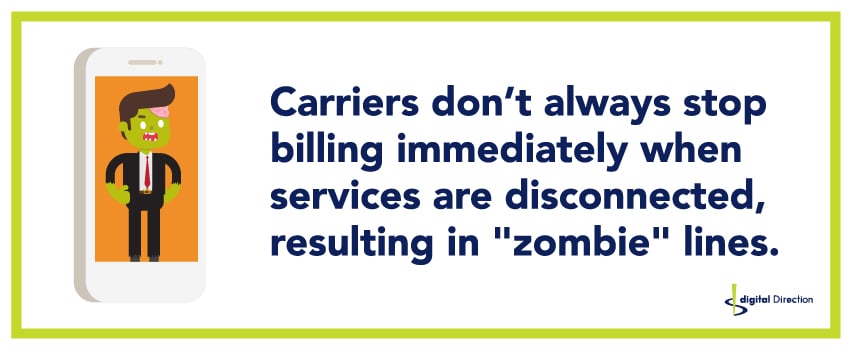
Carriers don’t always stop billing immediately when services are disconnected, resulting in "zombie" lines – inactive devices that still generate monthly charges. Without active proactive inventory management to catch these lingering charges, organizations often pay for services that haven’t been active for months.
Rate Misalignment
Contracted rates don’t always make it into the carrier’s billing system accurately, and they don’t always stay there. Rate increases can be applied without notice, while contract renewals may include new pricing that isn’t reflected in billing for months. Without ongoing contract-to-invoice validation, these discrepancies go unnoticed.
Duplicate Charges
Duplicate line items – where the same service is billed twice, under different account numbers or invoice formats – are more common in complex enterprise environments than most teams realize. They’re also easy to miss when invoices are reviewed at a high level rather than validated line by line.
Tax and Surcharge Errors
Telecom taxes and surcharges are governed by a complex web of federal, state, and local regulations that vary by service type and jurisdiction. Errors in how services are classified or how applicable tax rates are applied can result in systematic overbilling that adds up across every billing cycle and every location in your footprint.
What Should Effective Billing in Telecom Management Look Like?
Managing telecom billing effectively isn’t just about catching errors after the fact. It’s about building a process that prevents errors from persisting in the first place – and that creates ongoing accountability across carriers, invoices, and services.
The key components of an effective telecom billing management process include:
- Centralized Invoice Intake: All carrier invoices – regardless of format or delivery method – are collected, normalized, and processed through a single system. This eliminates the fragmentation that allows errors to hide across disconnected tools.
- Inventory-to-Invoice Reconciliation: Every billed service is cross-referenced against a maintained inventory of active services. Disconnected services stop billing. Services that shouldn’t exist get flagged.
- Contract-to-Invoice Validation: Every charge is compared against contracted rates and terms. Rate discrepancies are identified and documented for dispute.
- Structured Approval Workflows: Invoices route to the right reviewers before payment is released. Exceptions are flagged automatically. Routine approvals are handled without manual intervention.
- Proactive Dispute Management: Identified errors are disputed with carriers directly, with the documentation needed to recover credits – not just flagged for someone else to follow up on.
- Ongoing Optimization: Billing data is used continuously to identify right-sizing opportunities, plan misalignments, and renegotiation targets – not just reviewed reactively.

This is the operating model that we built Digital Direction’s Managed Telecom Solutions around. Rather than giving clients a platform and leaving them to manage the process themselves, we operate the billing management function on their behalf – auditing invoices, managing disputes, maintaining inventory, and executing approvals so the savings add up and the process runs without burdening internal teams.
Telecoms Billing Management Challenges at Enterprise Scale
The billing management challenges described above are challenging at any scale. At enterprise scale, they become significantly harder – for a few specific reasons.
Carrier Sprawl
Large organizations typically work with multiple carriers across different service types, regions, and legacy contracts. Each carrier has its own billing format, its own invoice delivery process, and its own dispute workflow. Managing billing effectively across 10, 20, or 30 carriers simultaneously requires a level of operational depth that most internal teams simply don’t have.
Multi-Site Complexity
Enterprises operating across hundreds of locations face a version of the billing problem that multiplies with every site. Each location may have its own services, its own carriers, and its own billing history. Without site-level inventory management, billing errors at individual locations go undetected indefinitely.
Organizational Silos
Telecom billing typically sits at the intersection of IT, Finance, and Procurement – three teams with different priorities and limited shared visibility into the billing process. IT understands the services, Finance manages the payments, and Procurement handles contracts. When these functions don’t have a shared system and process, billing errors fall through the gaps between them.
How To Take Control of Your Telecom Bill
Tired of managing telecom billing reactively? These three steps can help you build a more structured approach:
- Start with an Audit: A telecom audit establishes a clean, validated baseline by surfacing the full scope of your environment. For most organizations, an audit delivers immediate savings. Our clients at Digital Direction, for example, save an average of 35% in telecom costs after engaging with us.

- Implement a Billing Management Process: Whether through a TEM platform, a managed services partner, or a combination of both, establish a structured process for invoice intake, validation, approval, and dispute management.
- Move From Reactive to Proactive: The goal is to build an ongoing billing management model that prevents errors from persisting and continuously optimizes spend. That’s where the compounding savings come from.
Building an effective telecom billing management process like this in-house requires dedicated resources with carrier-specific expertise, the time to validate invoices at scale, and the operational discipline to follow through on disputes. That’s a significant investment – and for most IT and Finance teams, it competes directly with higher-priority initiatives.
Outsourcing billing management to a managed telecom partner like Digital Direction shifts that burden. As a partner with dedicated billing expertise, deep carrier relationships, and a structured dispute process, our team can find and recover more than internal teams managing billing as a secondary responsibility.
Stop Paying for Telecom Billing Errors You Shouldn’t Owe
Telecom billing is complex by design. Carriers aren’t going to simplify it for you, and they’re not going to flag their own errors. Without a structured management process, the default outcome is overpayment – month after month, carrier after carrier, billing cycle after billing cycle.
Digital Direction has spent 24+ years building the expertise, carrier relationships, and managed billing processes that enterprise organizations need to get telecom spend under control. We don’t hand you a dashboard and walk away. We do the work of auditing invoices, managing disputes, maintaining inventory, and optimizing spend, so your team doesn’t have to.
If you’re ready to find out what your telecom environment is really costing you, let’s start with a discovery call. We’ll assess your current billing environment and show you specifically where the savings are hiding. For qualified engagements, we stand behind our work with a savings guarantee.


%207%20Key%20Benefits/digitaldirection-feat-whatisTEM.jpg)