

When most enterprise leaders think about supply chain risk, telecom isn’t the first category that comes to mind. It should be. The carriers, equipment manufacturers, software vendors, and managed service providers that make up your telecom supply chain are responsible for the connectivity, collaboration, and security infrastructure your business actually runs on. A disruption in any one of them affects every other operation downstream.
And yet, telecom supply chain risk is one of the most overlooked categories in enterprise risk management. Carrier consolidation, hardware shortages, regulatory shifts, and cybersecurity exposure all create risk, and the threat landscape is only intensifying. There were 444 cyber incidents within the telecom sector in 2025,1 so organizations that don't apply the same scrutiny to their telecom suppliers that they do to other vendor categories are leaving themselves open to vulnerabilities.
Read on to learn what an effective telecom supply chain strategy should include, where the biggest risks come from, and how to build a strategy that actually protects your business.
What Is a Telecom Supply Chain?
The telecom supply chain is the network of suppliers that provide the services, equipment, software, and operational support an organization needs to run its telecommunications environment. For enterprise organizations, that network is broader and more complex than most people realize.
A typical enterprise telecom supply chain will include:
- Wireline and wireless carriers that provide voice, data, and connectivity services
- Cloud connectivity providers and SD-WAN platforms
- UCaaS and collaboration platform vendors
- Managed security and network security providers
- Hardware manufacturers for routers, switches, edge devices, and endpoints
- Software vendors for network monitoring, expense management, and operational tooling
- Managed services partners providing ongoing operational support
- Local installation, cabling, and field service providers
Each of these suppliers represents a potential point of disruption – and most enterprises depend on more of them than they actively track.
Why Your Telecom Supply Chain Strategy Matters More Than Ever
Several converging trends have made telecom supply chain strategy a more urgent issue for enterprise organizations than it was even a few years ago.
Carrier Consolidation Is Reshaping the Provider Landscape
Mergers, acquisitions, and divestitures across the carrier industry have changed who provides what services, where, and under what terms. Organizations with long-standing carrier relationships are increasingly discovering that the provider they originally contracted with is no longer the one delivering service, creating a range of contractual, operational, and pricing challenges.
Hardware and Equipment Supply Constraints Are Persistent
Lead times on networking equipment have stabilized somewhat from their pandemic-era peaks, but constraints still remain unpredictable. Edge devices, security appliances, and connectivity hardware can still face multi-month delays, which is long enough to derail transformation initiatives that didn’t plan for procurement risk.
Cybersecurity Risk Has Moved Down the Supply Chain
Recent high-profile attacks on telecom carriers and managed service providers have demonstrated that supply chain cybersecurity isn’t just an IT issue – it’s a board-level concern. While the risk sits with your suppliers, the liability often falls on your organization.
Regulatory and Geopolitical Pressure Is Increasing
Regulatory requirements around vendor diversity, equipment sourcing, and supplier transparency have expanded. If your business operates across multiple jurisdictions, you need to factor compliance into supplier selection in ways that were less central five years ago.
The 5 Core Telecom Supply Chain Risk Categories
Risk mitigation starts with understanding where exposure actually lives. Most telecom supply chain risk falls into one of these five categories:
1. Service Continuity Risk
This is the most immediate category – the risk that a supplier failure, outage, or business disruption interrupts the services your organization depends on. Single-carrier dependencies in critical locations, sole-source equipment vendors, and unmonitored carrier performance all increase exposure in this category.
2. Cybersecurity Risk
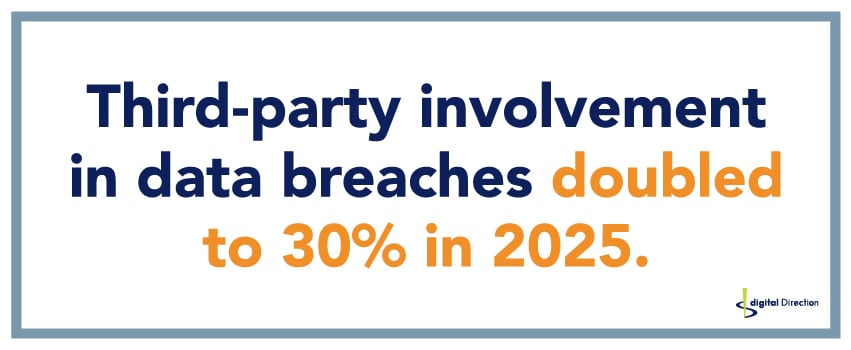
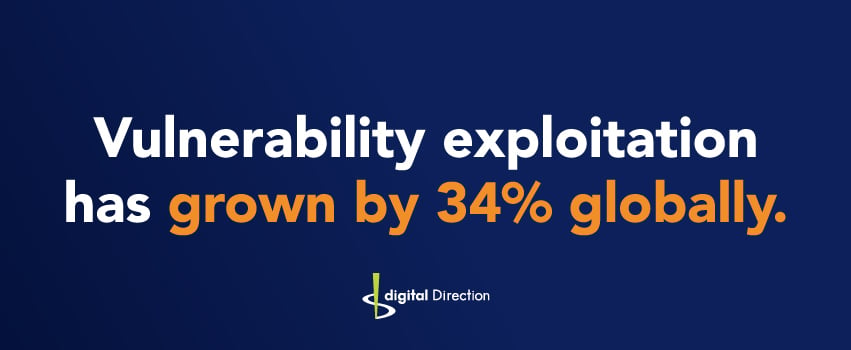
Third-party involvement in data breaches doubled to 30% in 2025, and vulnerability exploitation has grown by 34% globally.2 Telecom carriers, hardware manufacturers, and managed service providers all have access to your critical systems, traffic, and data, making them potential attack vectors.
3. Financial and Commercial Risk
Vendors experiencing financial instability or undergoing acquisition or restructuring all create financial risk for your business. Long-term contracts signed with a supplier that ends up changing ownership, declines in financial health, or shifts strategic direction can leave you holding unfavorable commitments.
4. Compliance and Regulatory Risk
Regulations affecting telecom suppliers vary by industry and geography. For example, healthcare organizations face HIPAA-related supplier requirements, while federal contractors face CMMC and other defense-related obligations. Suppliers that don’t meet the requirements that apply to your compliance landscape create direct exposure for your organization.
5. Operational and Execution Risk
Even when you've got the right suppliers locked in, the day-to-day work of actually using them creates its own problems. Slow carrier escalations, MACD errors, billing inaccuracies, and inconsistent service quality across providers all create ongoing operational exposure that adds up over time.
How To Build a Telecom Supply Chain Strategy That Mitigates Risk
A defensible telecom supply chain strategy isn’t a single document. It’s an ongoing operating model built around several interconnected practices.
Maintain a Complete Inventory
A maintained inventory of every supplier, contract, service, and location is the foundation on which every other supply chain risk practice depends. Without it, supply chain strategy is built on assumptions rather than facts.
Digital Direction’s Telecom Inventory Management service maintains a centralized, continuously updated record of every service, supplier, and carrier relationship across an enterprise telecom environment – the foundation for any meaningful supply chain risk program.

Diversify Critical Service Dependencies
Single-carrier dependencies create concentration risk that is easy to overlook and expensive to remediate. A mature strategy identifies the locations and services where concentration risk is highest and builds redundancy where the business case supports it – typically through secondary carriers, diverse routing, or hybrid network architectures.
Conduct Regular Supplier Assessments
Supplier risk changes over time – a vendor that was financially healthy three years ago might now be under acquisition pressure. Regular assessments can help you catch these shifts early by examining a supplier’s:
- Financial health and ownership stability
- Cybersecurity posture, breach history, and incident response capabilities
- Compliance certifications relevant to your industry
- Service performance and SLA history
- Coverage and capacity in your operating locations
Build Procurement Around Risk, Not Just Price
Procurement decisions made on price alone often introduce risk that doesn’t show up until the contract is underway. A supply chain strategy integrates risk evaluation into the procurement process by weighing supplier stability, performance history, and contract structure alongside pricing.
At Digital Direction, our Telecom Procurement services apply this discipline directly – evaluating providers across coverage, capability, financial stability, and fit before recommending any single direction.
Establish Incident Escalation and Continuity Plans
When a supplier disruption occurs, having predefined escalation paths, alternate routing options, and continuity plans is critical. A telecom supply chain strategy should include documented escalation procedures for major suppliers, alternate providers for critical services, and continuity protocols that activate when an event affects your operations. The time to plan your response isn't during the crisis.
Govern Contracts as Risk Management Tools
A well-structured contract is one of the most effective supply chain risk management tools available, if it's actually enforced. SLA remedies, termination provisions, security requirements, and rate protection clauses all need to be tracked and held to over the contract term.
The protections you negotiated at signing can degrade quickly without active contract governance. A contract that's not enforced is essentially a fantasy document that provides no actual protection.
Common Telecommunication Supply Chain Risk Mistakes to Avoid
Across the engagements we’ve led with enterprise organizations, the same set of telecom supply chain risk mistakes shows up repeatedly. Recognizing them is the first step in addressing them.
- Not Treating Telecom as a Supply Chain: Organizations that don’t actively manage their telecom suppliers in the same way they manage other critical vendor categories tend to discover supply chain risk only after a major disruption forces the issue.
- Optimizing for Price, Not Risk: Procurement decisions that lock in low-cost suppliers without evaluating financial health, security posture, or service track record routinely create exposure that costs more to remediate than the original savings.
- Letting the Supplier Inventory Degrade: A supply chain you can’t see can’t be managed. Inventory inaccuracy is the most common root cause of inability to respond effectively to supplier disruptions.
- Skipping Supplier Assessments: One-time supplier evaluations at procurement don’t capture the changes in financial health, ownership, security posture, and capability that happen across multi-year contracts. Supplier risk is dynamic, not static.
- Ignoring Carrier Consolidation: When a carrier acquires, merges with, or divests services, the implications for existing customers are often bigger than the immediate announcement suggests. Businesses that don’t actively reassess their position when consolidation happens tend to discover the effects later, after leverage has already shifted.
- Underinvesting in Carrier Accountability: Carriers don’t proactively meet commitments they aren’t held to. SLA monitoring, escalation discipline, and active carrier management are the operational practices that turn contractual protections into actual risk mitigation.
Once you recognize that you’ve made one (or more) of these mistakes, you can start to dismantle them – which is exactly what a structured telecom supply chain strategy does.

How Can a Managed Partner Improve Your Telco Supply Chain Strategy?
For most enterprise organizations, the challenge with telecom supply chain strategy isn’t conceptual. It’s operational. Sustaining the inventory accuracy, supplier monitoring, contract governance, and incident response infrastructure that effective risk mitigation requires is a meaningful resource commitment – and one that competes directly with higher-visibility initiatives.
A managed telecom partner with deep carrier and vendor expertise changes the equation. Rather than building and maintaining supply chain risk capabilities internally, organizations can rely on a dedicated partner to operate them – with the carrier relationships, market intelligence, and operational infrastructure that internal teams rarely have the bandwidth to develop.
Digital Direction’s Managed Telecom Solutions cover the operational disciplines that supply chain risk mitigation depends on – inventory management, contract governance, procurement, vendor evaluation, and ongoing carrier management. We act as the operational engine behind your supply chain strategy, so your team can focus on the decisions, not the day-to-day execution.
Don’t Wait for a Disruption To Build Your Strategy
The most expensive time to build a telecom supply chain strategy is in the middle of a supplier failure, an outage, or a major carrier transition. Organizations that wait for an event to force the issue spend significantly more on remediation than those that address supply chain risk proactively – and they make those remediation decisions under pressure, with limited time to evaluate alternatives.
Digital Direction has spent 24+ years helping enterprise organizations manage the operational realities of their telecom supply chain – from supplier inventory and contract governance to carrier coordination and incident escalation. Our managed approach gives organizations the operational infrastructure to mitigate supply chain risk without building those capabilities internally.
If your telecom supply chain has been growing on autopilot, let’s start with a conversation. We’ll assess where your current exposure sits and show you how a managed approach can protect your operations.
Sources: